
investment & partnerships
Help build what comes next.
Solpera builds its instruments, implements its experiments and runs its own compute. Investment and partnerships could help develop Spectrophage V2, bring the Atlas backpack to market and build out lab and workshop automation.
what has solpera built so far?
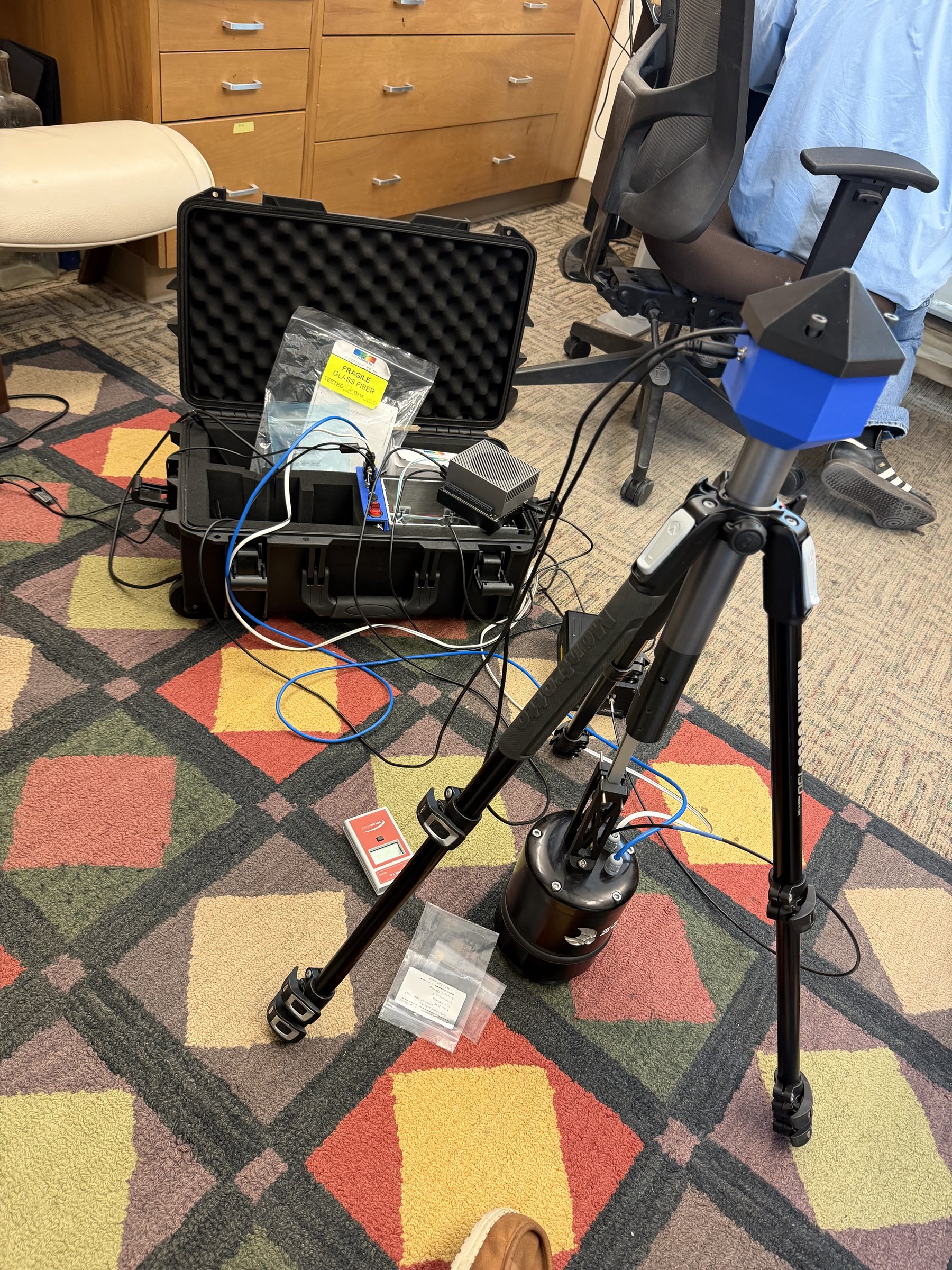
The physical Spectrophage prototype uses discrete UV-emitting channels to measure a material’s optical response over time.
A four-node DGX Spark system in Hobart supports Solpera’s locally managed compute work.
The Atlas backpack is in development for data acquisition and onboard computing on quadrupeds.
where the research stands
The prototype and laboratory work exist. The research remains a working hypothesis: establishing which responses are repeatable, what else could explain them, and where the method’s limits lie is the validation work ahead.
The first manuscript from the laboratory work is written and under internal review; nothing from the programme has yet been submitted for peer review.
the next milestones
Three connected development goals: better measurements of how surfaces respond through time, field systems that can carry the work further, and agentic AI built into the instruments and hardware that labs and workshops already use.
Spectrophage V2
Complete the next-generation instrument, calibrate its measurements and assess repeatability through laboratory and field trials.
Explore the V2 designBring Atlas to market
Complete sensor, power and onboard-AI integration on Spot. Test the system in the field, extend compatibility to a wider range of quadrupeds, and progress to system contracts and funded monitoring collaborations.
Explore AtlasBuild out lab & workshop automation
Begin integrating agentic AI, bespoke to each lab and workshop, so experiments and workflows run in English, with a person approving every plan. It already works on the Spectrophage, where an AI agent has run full days of laboratory measurements through the instrument’s own software while we placed each sample and gave the go.
Explore lab & workshop automationAntarctica · 2026–27 season
The Spectrophage goes to the McMurdo Dry Valleys this season with an Antarctica New Zealand science event. Antarctic microbial monitoring connects this engineering to climate-change research and our wider study of life in extreme environments.
what support would enable
- Engineering time
- People to complete the instruments, electronics, software and field integration, and to build agentic AI into the hardware labs and workshops already use.
- Calibration & equipment
- Manufacturing and calibration equipment to build and characterise the next instruments.
- Pilot builds & field trials
- Assembled systems, automation pilots, repeated testing and the practical work of taking measurements beyond the laboratory.
start a conversation
Speak with Mathew Youssef, Solpera’s founder, about investment, research partnerships, equipment, expertise, or access to relevant samples and sites. Tell us what interests you and what you would like to understand about the programme.