
the programme · an introduction
“Life is not adequately represented by a composition observed at one instant. Livingness describes a process of reconfiguration through time, and perturbation reveals that process by forcing the system to respond.”
the working hypothesis · everything below is how we test it
the question
Every definition of life we have was written from inside one. It describes the chemistry we grew up with, on the one planet we have measured closely, through the one set of senses we happen to own. A definition built that way is not obviously the right instrument for anywhere else.
The definitions in use are lists of things Earth life happens to do. A chemical system capable of Darwinian evolution is the standard formulation, but nobody meeting something unfamiliar is going to wait for it to evolve before deciding whether it is alive. Solpera works the problem from the measurement end: not what life is, but what a living phenomenon does that a nonliving one does not, and whether an instrument can watch it happen and characterise it in real time. We care about what livingness is in the most practical of contexts, so we can measure it, weigh it, watch it, and uncover it across our universe.
a snapshot is not enough
Remote sensing is clever and valuable, but one of its most obvious limitations is separability. Certain minerals absorb at the same wavelengths as the pigments living surfaces make, and a spectrum taken at one instant can leave nothing to separate them. Couple that with atmospheric attenuation and kilometre-wide pixels, and the picture becomes a mess. What separates them is history. A rock does not produce its absorber in response to energetic stimuli. A cyanobacterium does. That asymmetry is the whole measurement.
nothing is alive on its own
Take a spider out of its environment and put it in a glass box. Examine it and every test says alive: the legs work, the cells divide, it behaves like nothing you would call dead. Leave it there and it dies. Nothing about the spider changed. The context did, and the difference took time to appear.
The same holds at every scale, including the one that matters here. A cell in the dark and a cell in sunlight are not the same system, because the light is not incidental to the cell. The interaction is where the living happens. So the unit under measurement is never the organism alone. It is the organism and what is arriving at it.
the proxy
Cyanobacteria living under hard ultraviolet build photoprotective pigments to manage the influx of energy, either reflecting it or absorbing it. Either way the response is regulated and managed: the bacterium does not move with the energy gradient into destruction and death. The pigment survives desiccation and dormancy, so material that has been dry for years still carries the record of having managed light.
Ultraviolet is a universal problem: surface life on any world without an ozone shield has to manage it, and Mars poses the problem more sharply than anywhere on this planet, because its thin atmosphere passes harder, shorter-wavelength light than ever reaches Earth's surface. That is what makes photoprotection worth reading as a proxy for life, in Earth's deserts first and one day on the ground of Mars.
the method
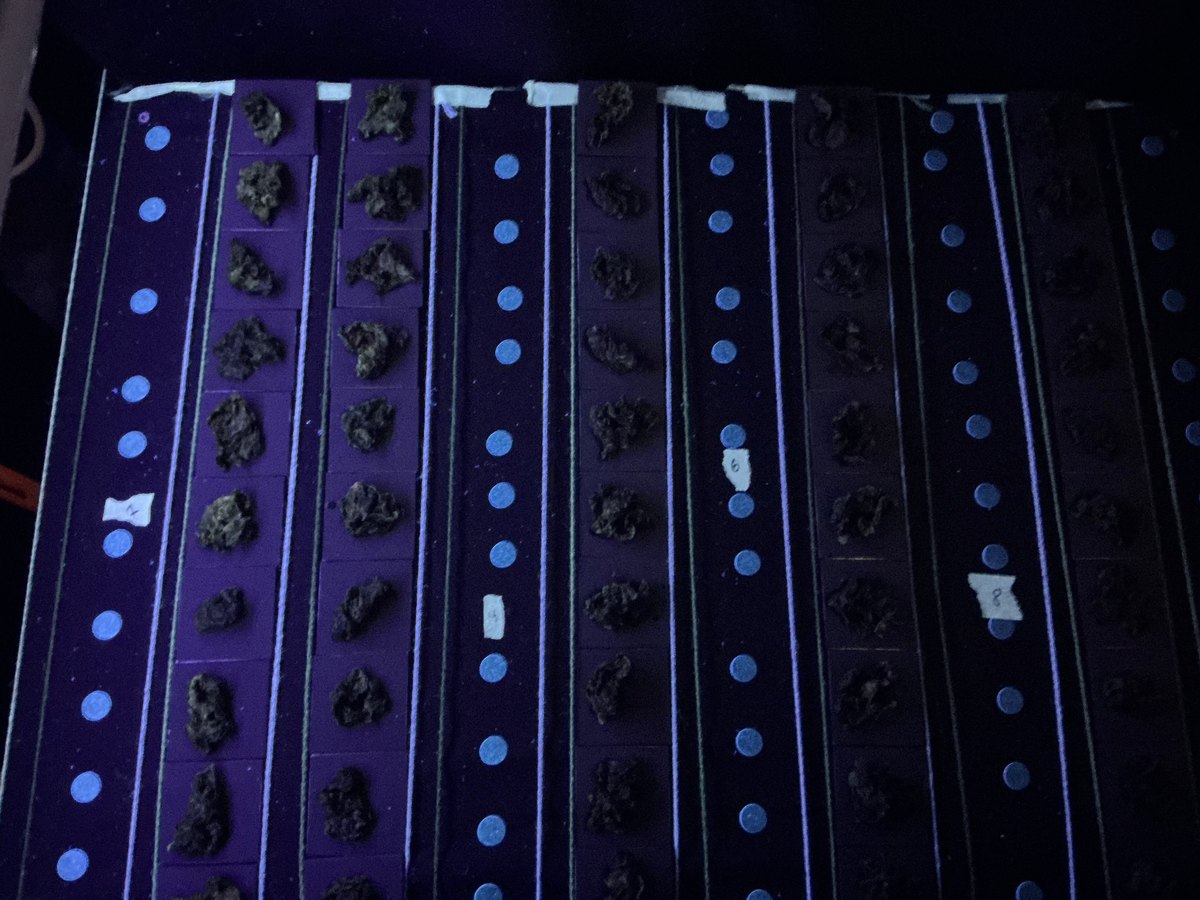
Provoke the surface, and measure what it does next. Deliver a controlled dose of the thing a living surface must manage, then read the same material before and after under locked acquisition parameters, so that the same physical sample becomes its own control. The question stops being what does this look like and becomes what changed, and in which direction. If the hypothesis holds, a living surface answers with regulation: induction after a lag, saturation, slow relaxation once the stress is removed. Dead biomass and bare mineral change too, but without regulation or memory.
the window
The pigment absorbs in the near ultraviolet, below where operational Earth imaging begins. The first bands of Landsat and Sentinel-2 start around 430 nanometres, and the ultraviolet instruments that do fly are kilometre-scale atmospheric sounders, blind to the ground at the scale of a crust. Of 52 published studies of ultraviolet reflectance in crop remote sensing between 1969 and 2020, none performed aerial remote sensing. Very little on the ground reads here either, so we built the instrument ourselves, sixteen ultraviolet channels reading 310 to 425 nanometres, and it carries its own controls. A measurement nobody else makes is a measurement nobody else can confirm, which is why the work is slow.
review: heath, st-onge & hausler (2024), plos one 19(3): e0285912
open questions
What separates a rock from a cyanobacterium, spectrally?
Not the wavelengths absorbed, which can coincide. The candidate answer is that only one of them produces its absorber in response to the light, which makes the discriminator a change under perturbation rather than a signature.
How much of the surroundings belongs inside the measurement?
Neither a rock nor a bacterium exists in isolation, and the light arriving is part of the system rather than a condition on it. Where the boundary is drawn changes what the reading means, and the boundary is currently drawn by the geometry of the instrument.
Which came first, the light or the sunscreen?
Probably neither. There is no reason to assume the cyanobacterium developed in an environment without light; more likely the capacity for managing light and the living system itself developed together, changing through time. The history is not observable. The response is.
where it goes
The ladder runs from culture plates to constructed soils to intact desert crusts to remote observation, each rung testing whether the signal survives the climb. The far end is the search for life on the ground of other worlds, conducted autonomously by robots and artificial intelligence that will traverse the stars. That exploration reaching the Moon, and then Mars, is an inevitability. The steps being taken now are the iterative building blocks that will host our species as a multiplanetary organism, part of a larger system, and with that responsibility must come a greater understanding of what life is, of what it means to be a living thing. We will measure and search for life on Mars because we must, for the sake of our humanity, understand what it means to be alive.
publications
in preparationThe first manuscript from the laboratory work is written and under internal review; nothing from the programme has yet been submitted for peer review. Papers will be listed here as they appear.